
Industry Overview
Clinical neurology practices are evolving into one of the most attractive segments of U.S. healthcare delivery. Demand is being fueled by the increased prevalence of neurological disorders, enhanced by aging populations. In turn, practices that can provide realistic physician access and integrated access to infusion, imaging, and ancillary services are increasingly attracting patients. At the same time, as an increasing number of infusion therapeutics become available, patients are finding more places for care, including dedicated infusion centers, hospitals and physician offices.
Neurology will remain in the forefront as research & development funding in neurological disorders is second only to oncology, and a wave of novel treatments for Alzheimer’s, Parkinson’s, and MS is driving demand. Practices are adapting through new operating models (greater APP-to-physician ratios, telehealth, and alternate site infusions) to expand access and efficiency. Taken together, these tailwinds are fueling an expected annual growth rate of 8.3% through 2034 for U.S. neurology services.1

Rajesh Kothari
Managing Director

Gary Sandhu
Vice President
Neurology Market Outlook: Demand, Innovation & Expansion
Operational Constraints
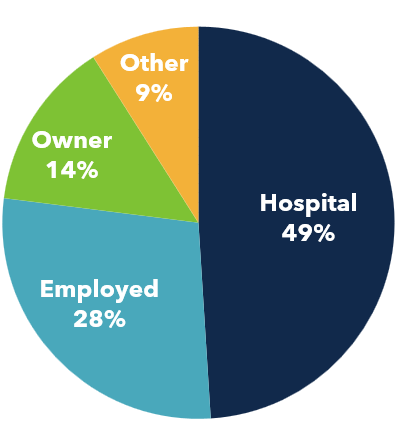
The growth in demand for general neurologists and specialists is evident in the makeup of their practices. The number of owned practices and employment in practices has increased, while hospital-employed neurologists have contracted since 2018, a sharp contrast to physicians as a whole.
Unfortunately, a 19% projected shortfall of neurologists this year and wait times exceeding 2 months are pressuring practices to accelerate APP deployment, telehealth, and other efficiency-focused workflows.3 The impact of this fragmented market with smaller practices creates clear dynamics for scale-driven operational efficiencies.
Increasing Burden of Chronic Neurological Diseases
Broader prevalence of migraines and neurodegenerative conditions continues to fuel long-term demand. Over the past 10 years, stroke incidence has increased nearly 8% and the number living with stroke has increased over 80%. Alzheimer’s affects over 7M5 Americans, up 55% since 2000. Parkinson’s diagnoses (~90K per year) are projected to reach 1.2M cases by 2030.6 Dementia-related costs alone are expected to grow from $384B in 2025 to ~$1T by 2050, underscoring system-wide pressure.5
Increasing Prevalence of Multi-modality, One-Stop-Shop Practices
With long wait times and recurring therapy needs, patients are seeking easier solutions. Aided by improved costs, outpatient infusion (including at home) is expanding to nearly $38.0B7 and ambulatory centers to $52.0B by 2034,1 presenting a significant ancillary revenue opportunity. Practices should consider imaging, infusion, behavioral health, and pharmacy to speed diagnosis and coordinated chronic care. All of which can be used to support value-based reimbursement, reduce readmissions, and streamline prior authorizations.
Sources: 1) Precedence Research, 2) Centers for Disease Control and Prevention, 3) American Academy of Neurology, 4) American Academy of Neurology’s 2024 Demographics Report, 5) Alzheimer’s Association. 2025 Alzheimer’s Disease Facts and Figures, 6) Parkinson’s Foundation, 7) Fortune Business Insights, 8) IQVIA
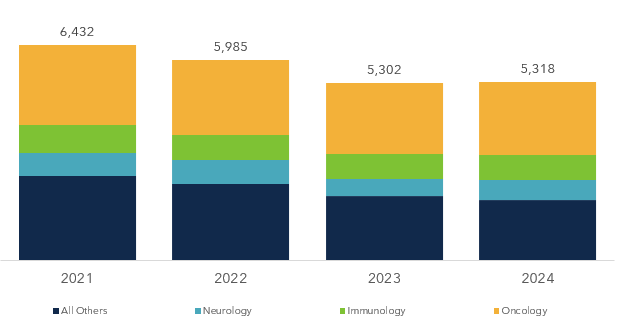
Clinical Trial Stats
by Therapeutic Area
M&A Activity in Clinical Neurology is Increasing
Fragmented Market with No Scaled Platforms: U.S. neurology remains highly fragmented, with most practices comprising 1–3 physicians. Unlike cardiology, dermatology, or GI, there is no scaled PE-backed national platform…Yet. While 15+ practices have transacted in the past five years, activity has been infusion-focused or small in scale, underscoring early sponsor interest and a white-space opportunity for platform creation.
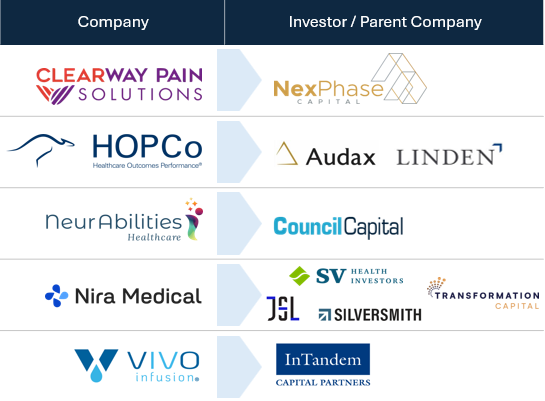
Vertical Integration Opportunities: Existing PE-backed infusion platforms are pursuing neurology practices to expand patient access and diversify revenue. Integrated, multi-modality groups offering infusion, imaging, EEG, and diagnostics present a compelling consolidation thesis, capturing higher-margin services while enhancing payer and pharmacy leverage.
Secular Demand Tailwinds: Neurologist shortages, aging demographics, and rising chronic neurological diseases are driving sustained volume growth, while U.S. medicine spending is projected to increase by $116B from 2024–2029, fueled by biologics and novel therapies that create a favorable backdrop for specialty growth and ancillary buildout.
Proven Playbook from Adjacencies: Oncology, rheumatology, and pain management have delivered strong sponsor returns with similar clinical and ancillary characteristics. Neurology offers a similar but untapped path with opportunities to replicate this model at scale via consolidation, ancillary buildout, and enhanced payer contracting leverage.
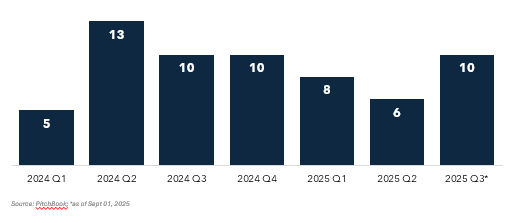
U.S. M&A Quarterly Deal Volume
Key Buyers
Select M&A Activity
Date | Acquirer | Target | Location |
| Aug-25 | AleraCare | Pure Infusion Suites (Build Capital Partners, Frazier Group) | AZ |
| Jul-25 | The Boster Center For Multiple Sclerosis | Singlepoint Healthcare (DFW Capital Partners) | OH |
| Mar-25 | FlexCare Infusion Centers | Optum (UnitedHealth Group) | OK |
| Jan-25 | Eastern Neurodiagnostic Associates | Clearway Pain Solutions (NexPhase Capital) | NJ |
| Dec-24 | Neurology Institute of San Antonio | Vivo Infusion (InTandem Capital Partners) | TX |
| Sep-24 | Progressive Health & Rehab | Central Ohio Spine & Joint | OH |
| Jun-24 | IVXpress | Ardian, Crescent Capital Group, Linden, North Sky Capital | TN |
| Jun-24 | New England Neurological Associates | Tufts Medicine (Lowell General Hospital, Tufts Medical Center) | MA |
| May-24 | Infusion Associates Management | Vivo Infusion (InTandem Capital Partners) | MI |
| Apr-24 | Midwest Neurological | Ascension Via Christi Hospital in Pittsburg | IN |
Select Transactions