by Eric Green
Managing Director
Consumer & Sports Construction Practice Lead
Cascade Partners


Managing Director
Consumer & Sports Construction Practice Lead
Cascade Partners
As the U.S. heads into autumn 2025, the consumer landscape presents a complex and cautionary picture. On the surface, conventional indicators suggest resilience: personal consumption expenditures rose 0.6% in August [1], supported largely by higher-income households leveraging gains in wealth and spending on services such as travel and dining, according to the Commerce Department. Retail sales increased for the third consecutive month in August, according to Bloomberg [2], highlighting continued activity despite tariffs and subdued consumer sentiment.
Yet beneath these headline numbers, structural stresses and shifting behaviors reveal a more fragile reality.
Household budgets are under mounting pressure from sustained inflation, rising housing costs, and elevated interest rates. PYMNTS Intelligence reports that 68% of Americans live paycheck to paycheck, with 25% of those households struggling to pay monthly bills, nearly matching record highs from the prior year.
Liquid assets have contracted sharply: the average U.S. household holds $9,869 in readily available cash, down 10% from 16 months ago, while households struggling to meet bills have just $2,336, a 27% drop [3].
Consumer sentiment underscores this strain. The University of Michigan’s Consumer Sentiment Index fell to 55.1 in September, down from 58.2 in August, marking a roughly 5% decline and the lowest reading since May [4]. While still above early-year lows, the drop reflects broad-based weakness across age, income, and education groups, highlighting growing concerns over tariffs and inflation.
Similarly, the Conference Board’s Consumer Confidence Index dipped to 97.4 in August, with expectations remaining below 80, a level historically associated with recession risk [5].
A deeper structural risk is emerging as the U.S. consumer economy becomes increasingly reliant on a small share of high-income households. Bloomberg reports that the top 10% of earners now account for 49.2% of total consumer spending, the highest level since 1989 [2]. This concentration creates vulnerability because any negative shock affecting wealthy households, whether from an asset-market correction, tax changes, or shifts in confidence, could disproportionately reduce aggregate demand.
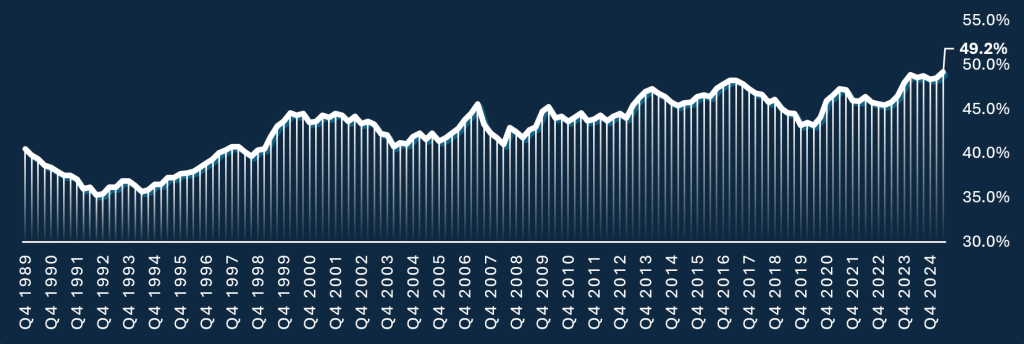
Meanwhile, the lower 80% of households have seen spending only keep pace with inflation, while rising debt delinquencies and softer hiring signal broader stress [2].
Labor market conditions compound this risk. The Labor Department reported that August 2025 saw only 22,000 new jobs [6], with losses in manufacturing, construction, and professional services offsetting gains in healthcare and social assistance. Unemployment ticked up to 4.3% [6], and opportunities remain constrained for younger entrants to the workforce, particularly in the context of new tariffs and trade uncertainty.
American consumers are adjusting their behavior in response to financial pressures. Grocery trends illustrate a clear shift toward value: sales of Hamburger Helper surged 14.5% through August [7], while rice purchases increased 7.5% [8], and demand for canned fish, beans, and boxed macaroni also rose, according to data from Eagle Foods and Circana.
Conversely, indulgent items such as ice cream and cookies are seeing declining sales. Dining out is also affected: fast-casual chains like Cava, Sweetgreen, and Chipotle experienced slower same-store sales, while McDonald’s relaunched “Extra Value Meals” to win back cost-conscious customers.
Beyond traditional indicators, unconventional signals provide additional insight. Cardboard box shipments, often used as a proxy for consumer goods movement, have fallen to multi-year lows, according to Packaging Gateway [9]. These declines reflect reduced spending, cost pressures from tariffs, packaging innovations, and slower production in the construction and durable goods sectors. Importantly, they underscore tightening budgets among lower- and middle-income households, as even modest discretionary purchases are being scaled back.
Similarly, historically resilient discretionary spending, captured in measures like the ‘Lipstick Index’ or the broader ‘Little Treat’ economy, is showing restraint.
The cumulative impact of these shifts is a bifurcated consumer landscape: resilient in higher-income segments but increasingly stretched among lower- and middle-income households. The Federal Reserve’s CPI data shows that urban consumers now pay roughly 25% more for the same basket of goods than five years ago, forcing households to trade down, delay discretionary purchases, and recalibrate expectations for financial security [10].
For businesses, these dynamics underscore the importance of diversifying customer bases and monitoring behavioral signals beyond headline spending numbers. Heavy reliance on wealthy households introduces volatility, while constrained middle- and lower-income segments may limit overall market growth.
For policymakers, these trends highlight structural vulnerabilities: supporting labor market expansion, mitigating inflationary pressures, and ensuring broader access to disposable income are critical for sustaining economic momentum.
As 2025 unfolds, businesses and policymakers must carefully read these signals. The American consumer remains resilient but faces heightened economic stress. Spending is increasingly concentrated, discretionary choices are more constrained, and behavioral shifts are reshaping markets in subtle yet meaningful ways.
Observing both conventional indicators, such as employment, CPI, and retail sales, as well as unconventional signals, including cardboard box shipments, budget meals, and discretionary spending patterns, provides a nuanced understanding of consumer health and potential risks. In an economy increasingly reliant on a narrow base of high-income households, attentiveness to these trends is essential for anticipating demand, managing risk, and supporting sustainable growth.
Sources: [1] Bureau of Economic Analysis; [2] Bloomberg; [3] PYMNTS Intelligence Reports; [4] University of Michigan Consumer Sentiment Index; [5] The Conference Board; [6] Bureau of Labor Statistics Employment Situation Summary; [7] Eagle Foods; [8] Circana, as reported by The New York Times; [9] Packaging Gateway; [10] Federal Reserve Consumer Price Index Data.